|
Task Management Software |
 |
|
|
|
|
| |
|
 TESTIMONIALS TESTIMONIALS
|
|
"...This is an excellent program. I'm so glad that I stumbled on to this when researching for task management programs. Very low learning curv, quite flexible, and the price is right. Tried at least 20 other programs, either too complicated, too expensive, or poor documentation..."
Chad Lindsey -
Honolulu, HI
|
|
|
|
|
|
|
|
Business Event Checklist |
|
|
|
|
|
|

 |
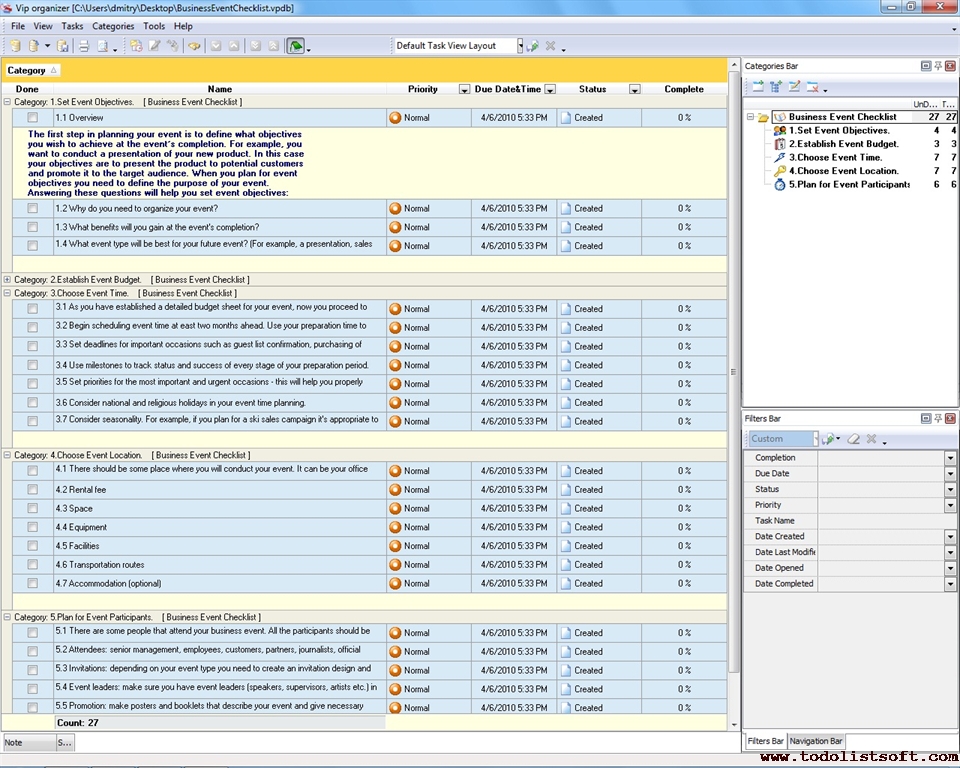
Successful planning of business events is always a challenge that requires planners to do their best to consider event details and make necessary preparations. If you need to plan a business occasion, you can use this Business Event Checklist that helps handle the challenge.
|
| Order 750 checklists in MS Word and PDF printable format at $49.99 USD only. |
BUY NOW!  |
1. Set Event Objectives.
The first step in planning your event is to define what objectives you wish to achieve at the event’s completion. For example, you want to conduct a presentation of your new product. In this case your objectives are to present the product to potential customers and promote it to the target audience. When you plan for event objectives you need to define the purpose of your event. Answering these questions will help you set event objectives:
- Why do you need to organize your event?
- What benefits will you gain at the event’s completion?
- What event type will be best for your future event? (For example, a presentation, sales campaign, meeting, concert, private party, official forum, social media conference, and so on).
2. Establish Event Budget.
When you have set objectives for your upcoming business event, your next step is to establish event budget. You will need to define an amount of financial resources that will cover all the expenses and ensure successful accomplishment of your objectives. A detailed budget document will help you take into account everything required for financing your event. Note that your budget sheet should include a cushion of at least 15% to 20% to take care of overhead costs and unpredicted expenses. We recommend you to break down your budget sheet into two components: Potential Revenue Sources and Costs.
- Potential Revenue Sources. Your event may generate some revenue and in such a case your task is to count all the sources of income and document this information in your budget sheet. For example, there can be such revenue sources as:
- Sponsorship
- Charity
- Event Fees
- Costs. Certainly your event will require some investments that should be recorded as costs in your budget. Here’re examples of expenses that your event may generate:
- Ceremony fees
- Rental fees
- Event promotion and advertizing fees
- Audio-visual equipment.
- Collateral fees, including prizes, medals, certificates etc.
- Entertainment fees
- Decoration fees
- Transportation fees
- Food and beverages
3. Choose Event Time.
As you have established a detailed budget sheet for your event, now you proceed to planning of event timeline. You can schedule event duration, start date and breaks. Also you need to consider preparation time. It’s recommended to use time management software to make event timelines, schedules and calendars. Please follow these tips to create your event timeline:
- Begin scheduling event time at east two months ahead. Use your preparation time to maximize advertising efforts.
- Set deadlines for important occasions such as guest list confirmation, purchasing of necessary attributes, etc.
- Use milestones to track status and success of every stage of your preparation period.
- Set priorities for the most important and urgent occasions – this will help you properly allocate resources and get your event scheduled correctly.
- Consider national and religious holidays in your event time planning.
- Consider seasonality. For example, if you plan for a ski sales campaign it’s appropriate to conduct such an event during the winter season.
4. Choose Event Location.
There should be some place where you will conduct your event. It can be your office premises or some rented space. When planning for event location you need to consider the following aspects:
- Rental fee
- Space
- Equipment
- Facilities
- Transportation routes
- Accommodation (optional)
5. Plan for Event Participants.
There are some people that attend your business event. All the participants should be notified of the event time, duration, location and other details. When planning for your participants, you need to consider the following:
- Attendees: senior management, employees, customers, partners, journalists, ...
| Order 750 checklists in MS Word and PDF printable format at $49.99 USD only. |
BUY NOW! |
|


 |
CentriQS Tasks Management Solution 
Looking for multi-user task management software? Try CentriQS complete task management solution for planning, tracking and reporting tasks, projects, and schedules. Increase productivity of your small business or office by better organizing your employees' tasks and time.
 FREE Download CentriQS FREE Download CentriQS
|
|
|
|
|
|
|
|
|
|
| CentriQS -15% OFF |
All-in-one business management software
for small and midsize enterprises |
|
|
|
| VIP Task Manager |
Multi-user project management software
to plan, schedule and track project tasks. |
 |
|
|
| VIP Checklists
|
More than 750 ready-to-use to-do lists
to plan your personal and business life |
 |
|
|
| VIP Team To Do List |
Professional task management software
to make and send team todo lists by email |
 |
|
|
| VIP Organizer |
Personal time management software
to organize time at home and at work |
 |
|
|
| VIP Simple To Do List
|
Simple and effective to-do list software
to plan daily chores, trips, wedding, etc. |
|
|
|
|
|
|
|
|



 Play Demo >>